The Richer, Fuller Story behind “O Love That Will Not Let Me Go” by George Matheson

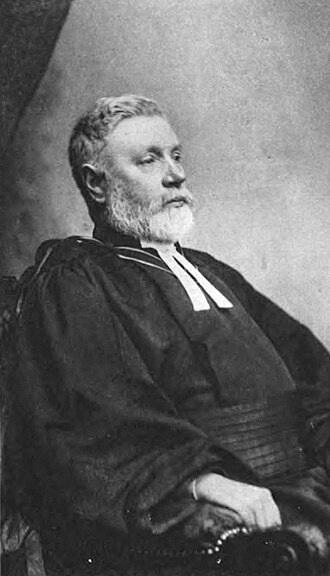
George Matheson image in public domain accessed via Wikimedia Commons.

I’m always a little suspicious of what I call “just-so stories,” ones that seem too neat and tidy in drawing straight lines to explain human actions. The “just-so” on the lyrics of “O Love That Will Not Let Me Go” says that George Matheson, a Scotsman living in the mid-1800s, was going blind. He had been at university and engaged to be married, but when he told his fiancé the news of his impending blindness she refused to marry him. So his sister became his housekeeper, assistant, and companion. She helped him with his scholarship as he became a prominent theologian and preacher, even learning Greek and Hebrew so that she could read those texts to him. 20 years later, though, she married. Matheson was heartbroken as he contemplated being alone again, perhaps reliving the rejection he had felt when his fiancé had ended their relationship. Out of his grief he penned the famous four-stanza poem that is the subject of this post.

It could certainly have happened that way, but real life is always messy. For one thing, we have no definitive source about this supposedly unfaithful fiancé, just a few allusions that say he “might have” been involved with a young woman who broke his heart. Here’s what one old hymnbook has to say: “There is a story of how years before, he had been engaged until his fiancé learned that he was going blind, and there was nothing the doctors could do, and she told him that she could not go through life with a blind man.” Not a lot of corroborating detail here, it must be said. And Matheson didn’t suddenly realize that he was going blind; in reality, his vision was never very good and steadily deteriorated over time. While at school he was able to make out texts by the use of a strong magnifying glass and always sat near the front of the classroom in order to see the board. He could see faint outlines and shadows throughout his life, but his poor vision made him almost totally dependent on others for the practicalities of daily life. Although the system of Braille writing for the blind had been invented in 1824, I don’t see any references to his use of it. In spite of these limitations, however, his list of accomplishments would be truly remarkable even for a sighted person. He published books, produced sermons, gave lectures, and even preached before Queen Victoria, all without being able to read or write without the aid of a secretary. His sister, Jane Gray Matheson, filled that role at least until she married, and he gave her credit for her help in his own works.


Read more

An Illuminating New Work–Elaine Hagenberg’s “Illuminare”

A Composer Composes

Image by Stefan Keller from Pixabay

Elaine Hagenberg’s Illuminare burst on the classical choral scene in 2022 with initial performances by member choirs of a commissioning consortium. My own choir, the Cherry Creek Chorale in the Denver area, was privileged to be a part of this group and to perform the work in March 2022. We had the additional privilege of having Ms. Hagenberg on board for our final rehearsal. The composer was a full collaborator that evening, listening and critiquing gently but firmly. She clearly knew exactly how she wanted the piece to sound, and we benefited greatly from her input.  I’m reminded of something that the director of my choir, Brian Patrick Leatherman, said when we started working on the piece: “This is going to be big.” He also said that when he’d been contacted about our participation in the consortium he’d “JUMPED AT!” it. I’d say that his enthusiasm has been fully justified. Illuminare was made available for sale in August 2022 and is now being performed widely all over the world. A gala performance in Paris is scheduled to take place on June 24, 2026; this concert will also include the performance of a new major Hagenberg work. I hope to write about the texts of that composition at some point.

Read more

Streams of Meaning in Shawn Kirchner’s “Sweet Rivers”

Jordan River near Chorazin (Seetheholyland.net)

 Have to tell you that I’ve just finished doing a deep dive into the career of the composer/songwriter of “Sweet Rivers,” Shawn Kirchner, and I am exhausted. You can read his professional bio on his website1 if you’d like; just be sure you’re sitting down before you start.

Although Kirchner was classically trained, his compositions have become more and more attuned to popular music, whether folk, jazz, or bluegrass. Within those categories he’s written many sacred pieces, one of which is “Sweet Rivers,” pairing text by the itinerant preacher John Adam Granade with his own tune. Granade was an active participant in the “Great Revival in the West” that’s usually dated to 1800 and is part of the “Second Great Awakening” that swept over the Northeast and Midwest US especially, although outbreaks of religious fervor occurred all over the nation. Granade was known as “the wild man of Goose Creek” (a settlement in Tennessee) and became a prolific hymnwriter. Here’s a description of his behavior:

Read more

Why is the song “Amazing Grace” so popular, and, as a sidenote, why is it seen as particularly suitable for the bagpipes?


A Canadian bagpiper playing “Amazing Grace” during a memorial service, 29 October 2009, at Forward Operating Base Wilson, Afghanistan. Image soure Wikipedia

Probably everyone who’s attended some kind of Christian funeral has heard this hymn, as it’s especially popular for those occasions. And you can see why. The words are beautiful and striking, and the melody is at the same time lovely and singable. What’s not to like?

Then there’s the backstory to the song, which contains drama and irony in about equal parts: John Newton, a slave trader, is converted to Christianity and leaves his dreadful business, becoming a part of the anti-slavery movement. We all love a good redemption story, don’t we?

Real life, however, is seldom if ever so simple and straightforward. The more you delve into a person’s actions the more complicated and messy they become. I used the example in an earlier post about fractals, those designs that reveal new layers as they are magnified. There is never an end to the detail. The same is true in your life, even if you think of it as rather mundane. So it is with John Newton.

Read more

Amazing Grace Part II: How did a hymn written by a former slave trader become an icon of the civil rights movement?


JohnNewtonColour.jpg
Contemporary portrait of Newton; image source Wikipedia.

We left John Newton on the way back to England after having been rescued from slavery to the African Princess Peye. Be sure to go back and read Part I if you haven’t done so already to find out how he got himself into this pickle to begin with. The ship ran into a severe storm off the coast of Ireland and almost sank. At this point of crisis Newton turned to God, praying for mercy. The storm died down and the ship was able to reach port. For the rest of his life Newton marked the anniversary of this event: March 10, 1748. However, he didn’t give up participation in the slave trade, signing on with a slave ship after he got back to England and making several more voyages. He did not leave active participation in this horrible business until he suffered a stroke in 1754, when he stopped going to sea but continued to invest in others’ efforts. It isn’t clear to me exactly when he gave up even that support of slavery. Here’s a good summary from Wikipedia, however:

Read more

A Compact Masterpiece–Mozart’s Coronation Mass

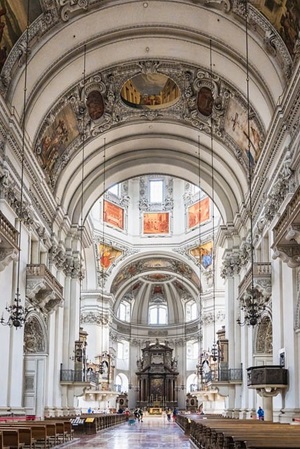
Interior of Salzburg Cathedral, where the first performance of the Coronation Mass probably took place. Image source: Image by 🌼Christel🌼 from Pixabay

Unemployment is a terrible thing—except when it leads to the composition of a masterpiece. In Mozart’s case he was only 23 years old when he wrote his Coronation Mass in 1779, having reluctantly taken up once again the position of court organist and sacred music composer in Salzburg after having failed to find anything more attractive over 16 months of traveling around Europe. He heartily disliked his birthplace Salzburg, considering it to be a backwater, and he also disliked his employer, Archbishop Hieronymous Colloredo. Mozart’s position lasted only two years, at which time the Archbishop decided he’d had enough of his court composer’s frequent absences and disrespectful behavior. Mozart describes in a letter being “kicked in the backside” by the Archbishop’s steward, an act which ended his career in Salzburg. He’d go on to (some) fame and (less) fortune in Vienna, where he would live for only ten more years.

During his time at the Archbishop’s court he wrote only two masses, one of which is rarely performed and the other is the one labeled “coronation” for reasons that remain somewhat murky. Mozart had written about a dozen masses before returning to his native city, but this would be the first one published, and it was probably first performed on Easter Sunday, April 4, in the Salzburg cathedral. He dated the mass’s completion as March 23, so the choir, soloists and orchestra had less than two weeks to prepare. Yikes! (But they were, after all, paid professionals.)

Read more

The Text of the “Te Deum”

Imagine yourself to have traveled back in time to around 400 A.D. You’re in the Italian city of Milan, standing in the Basilica of Saint Lawrence, at this point a Roman Catholic church but showing definite signs of its early origins in the Roman Empire. Suddenly you hear a choir of monks start to sing a hymn (I almost wrote “an ancient hymn,” but of course to them it’s brand new) starting with the words “Te Deum.” ‘Hmmm,’ you might think. ‘I’ve sung those words myself in October 2024 with the Cherry Creek Chorale, my own wonderful choir. Cool!’  This (now) ancient hymn is usually dated to around 390 and seen as possibly written by either Saint Ambrose or Saint Augustine. Or perhaps someone else, for all we know. Whoever wrote it, however, surely knew what he (or she!) was doing. Some real heavy hitters over the centuries have taken a crack at it, with one of the most famous being Franz Joseph Haydn in around 1800.

Haydn was a tremendously prolific and popular composer. His output is astonishing: this evening I scrolled through the list of his compositions on Wikipedia, and honestly–I think it probably took me longer to do that than it took Haydn to write the piece. He produced a huge range of compositions, from symphonies to oratorios to string quartets to masses to operas to folk song arrangements to everything else you can possibly imagine. (If there had been MOOG synthesizers around back then, be assured that he’d have written a concerto or two using that instrument.) The composer spent 30 years under the patronage of the Hungarian Prince Esterhazy, who was extremely jealous of Haydn’s time. The patronage was therefore both a blessing and a curse: Haydn had an assured income, but he was also limited in his ability to travel and to take on other commissions. The prince was finally persuaded, however, to allow Haydn to fulfill the request from the Austrian Empress Maria Theresa to write her a setting of the “Te Deum.”

Read more

The Long and Winding History of “Ain’t No Grave”

Image by person678 from Pixabay

I used to get a Sunday newsletter from a journalist named David French, and he’d always include a video of a contemporary worship song. I’m not a big fan of such music as a usual thing, finding most of it syrupy and breathy. (Sorry!) But I’d usually click on the video at least briefly, and one Sunday he’d put up a performance of “Ain’t No Grave” with a singer named Molly Skaggs. Hmmm, I thought, is she related to Ricky Skaggs, the great bluegrass performer?

Oh my! She is indeed his daughter, and a worthy representative of his musical tradition. I don’t know how many times I’ve watched/listened to that video. (It’s great for getting myself going on cleaning up the kitchen.) I love the words, and the music, and Molly standing there with her acoustic guitar and belting out the song. No glamor, no glitz—just pure talent. Later I found out that the song had been covered by many, many artists—including Johnny Cash. (After I insisted that my whole family watch the video my son said he really liked the song, and when I expressed astonishment he said, “Someone made an animation sequence to go with the Johnny Cash version.” Oh.)

Read more

What’s the Mystery in “O Magnum Mysterium”?


Master of the Nativity of Castello (fl. 1450–1500), image accessed via Wikimedia Commons, public domain

I’d always kind of assumed that the answer to this question would involve something high-flown and theological about the incarnation of Christ, but that’s not really the case. This text, which has been set to some of the most sublime music ever written, is all about the earthy details of the Christmas story. Does that surprise you? It did me, when I actually took the time to look at the translation.

Before I go any further, here’s the Latin original with the English version:

[one-half-first]

O magnum mysterium,
et admirabile sacramentum,
ut animalia viderent Dominum natum,
iacentem in praesepio!
Beata Virgo, cujus viscera
meruerunt portare
Dominum Iesum Christum.
Alleluia![/one-half-first]

[one-half]

O great mystery,
and wonderful sacrament,
that animals should see the newborn Lord,
lying in a manger!
Blessed is the virgin whose womb
was worthy to bear
the Lord, Jesus Christ.
Alleluia!

[/one-half]

How Did John Tavener’s “Song for Athene” Become Associated with British Royalty?

Pallbearers leaving Westminster Abbey at the end of Diana’s funeral, as they were accompanied by “Athene.” Image accessed via Parade Magazine.

John Tavener was one of the most intriguing, unconventional, and prolific composers in British music, but it’s fair to say that at least for Americans he’s known for only a couple of pieces, notably “The Lamb” and “Song for Athene.” When my own choir sang that first piece I was woefully ignorant about Tavener, thinking that he was some sort of musical flash in the pan. After all, he’d said, “‘The Lamb’ came to me fully grown and was written in an afternoon and dedicated to my nephew Simon for his 3rd birthday.” Doesn’t that quotation make him sound like someone who just jots down musical compositions as the inspiration strikes him, without taking too much thought?

In reality, this picture of John Tavener as a dilettante is very misleading. As I’ve read about the composer’s work and life (he died in 2013 at the age of 69), it’s become very clear that he worked extremely hard on his compositions and took his work very seriously. He also took his religious faith seriously, converting to the Eastern Orthodox Church in 1977. But don’t think that he was some kind of stern and forbidding sourpuss! He also loved fast cars and had a famous collection of them. He seems to have been one of those rare people who just plunges into life in all sorts of ways. This zesty approach is all the more fascinating when you realize that he suffered from serious health issues for most of his adult life, having had a serious stroke in his thirties as well as several heart attacks and cancer. This panoply of disorders probably stemmed at least partially from the fact that he had a condition called “Marfan’s syndrome,” a genetic disease that attacks the heart and usually leads to abnormal height. Tavener was 6 feet 6 inches tall; most medical historians believe that Abraham Lincoln suffered from the same disease. But Tavener (like Lincoln) didn’t let his suffering dampen his humor: “He told a reporter from London’s Guardian newspaper that doctors couldn’t pinpoint a cause of some of the pain he was enduring. ‘All they ever say is, “You’re lucky to be here at all!’” Tavener said, ‘which is charming.’” But he also saw the spiritual side: “Suffering is a kind of ecstasy, in a way. . . . Having pain all the time makes me terribly, terribly grateful for every moment I’ve got.” (both quotations from “In Memoriam of a Genius”)

Read more