Why, you might ask, is the Cherry Creek Chorale singing a quintessentially American piece in a German-themed program? “Well,” said our artistic director Brian Leatherman, “it’s America’s 250th, and so . . . we wanted to put it in.” I can’t argue with his reasoning, especially since its inclusion caused me to think about the words of this song in a way I hadn’t done so before. What’s up with those alabaster cities? And who was Katherine Lee Bates, the author of the lyrics? If put to the test I’d probably have pictured her gazing out of the window of her farmhouse over fields of wheat to see the line of Rocky Mountains in the distance. (Yes, you can in theory see them from as far away as western Kansas.)
Well, no—at least not officially in terms of being Austria’s national anthem or anything like that. But the choice of this little Alpine flower as the centerpiece of an iconic song in the musical does indeed come from its cultural significance. So I guess the real answer is yes, kinda sorta. (You can hear a beautiful choral arrangement sung by my own choir, the Cherry Creek Chorale, if you come to our October concert in the Denver area. Follow this link to get your tickets now! Note that there’s a special post-concert reception for the Saturday matinee that is separately ticketed. I’m in charge of the desserts!)
I’m not going to be able to tell you exactly how the lyrics to this song occurred to Oscar Hammerstein III. What we do know is that “ten days before The Sound of Music opened on Broadway, Richard Rodgers felt something was missing. He decided that the non-singing Captain Von Trapp needed his own signature tune: a chance for the grumpy ‘good Austrian’ to say farewell to his beloved homeland.” There is a mention of the flower in the actual script, or book, of the musical, written not by Rodgers and Hammerstein but by the team of Howard Lindsay and Russel Crouse. I looked up the scene—Gretl, the youngest of the seven von Trapp children, presents a single edelweiss to Baroness Elsa Schraeder, Captain von Trapp’s current love interest at the beginning of the show. I’m sure that the scriptwriters just thought, Hmm. Gretl should present a typical Austrian flower to her possible future stepmother. What would that be? And they decided on an edelweiss, or “noble white.” (Are you curious about how this whole writing-a-musical works? Read the first couple of paragraphs in this post.) So it wasn’t much of a leap for Hammerstein to use the flower in the Captain’s final song.
If you’ve ever sung “99 Bottles of Beer on the Wall” (with or without actual beer drinking involved), then you know perfectly well the answer to the title’s question. The lyrics simply list a set of reasons why it’s always, always a good idea to drink beer, or ale, or anything else alcoholic, rather than to consume anything else. And since this is a folk song there are a number of variations; I’ll include these as well as the lyrics in the John Rutter arrangement that the Cherry Creek Chorale will perform in our October concert, “Harmony and Hops.” (Be sure to come if you can! Here’s the link to buy your tickets.)
Rutter set this text to his own music instead of that found in the original 15th century manuscript, calling upon the accompanists (either the original small orchestra or the piano reduction) to convey a sense of increasing inebriation even while the choir is supposed to maintain “strong rhythm and well-projected text” to the end.”1 The Chorale will try to fulfill this direction!
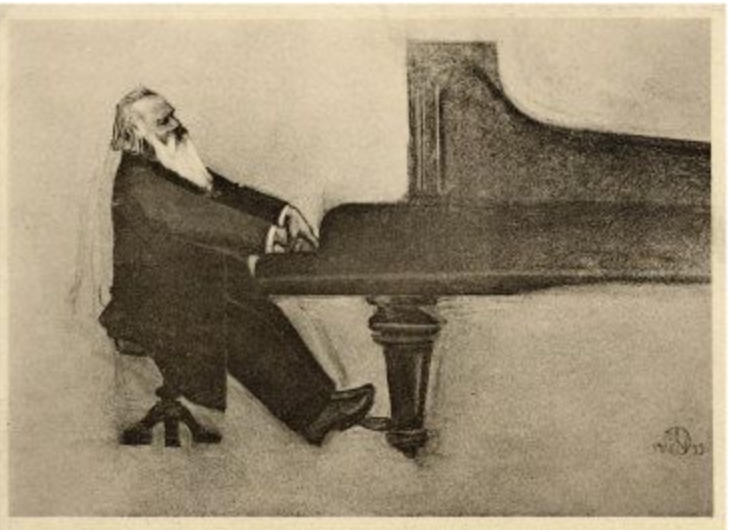
Betcha were a little surprised to see that Brahms even had such a side. Isn’t he rather . . . monumental for such a description? After all, isn’t he one of the three B’s of classical music, along with Bach and Beethoven? Bach certainly wrote lighter music–his “Coffee Cantata” contains the immortal lines “If I can’t drink my bowl of coffee three times daily, then in my torment I will shrivel up like a piece of roast goat.” You can’t quite picture Brahms, or for that matter Beethoven, writing something that silly.
But there were several aspects of Brahms’ life that lent themselves to his writing this music. First, he loved getting together socially with his circle of friends to discuss and perform chamber works. Second, he felt the need for somewhat lighter composing as a relief from his work on Symphony No. 1, an endeavor that took him 21 years. Third, he was always falling in love with unattainable women. Oh dear! First (we think) he fell in love with the wife-then-widow of Brahms’ mentor Robert Schumann and then with a succession of already-taken younger women, one of which was the Schumanns’ daughter Julie. Whew! And, last but not least, Brahms was greatly influenced by the earlier composer Franz Schubert (editing some of Schubert’s music for publication), by Robert Schumann, and by the Waltz King Johann Strauss. The first two wrote many songs, some based on folk tunes, and Strauss of course took the public by storm during his career. Those composers’ lives span from 1797 (Schubert’s birth) to 1899 (Strauss’s death). And there’s Brahms, smack in the middle, living from 1833-1897. But Brahms also kept a pretty canny eye on the musical scene, and it can be said that “these works, in a deliberately popular style, were overwhelmingly responsible for spreading Brahms’ reputation to the general music-buying public, and became the chief source of his personal wealth.”1 After the success of the original Opus 52 set of 18 pieces published in 1869 Brahms went ahead and produced another set of 15, Neue Liebeslieder Walzen, Opus 65. published in 1865.
Here’s the thing, folks: If you’re funny, no one takes you seriously. But in order to be funny you have to be serious about whatever it is that you’re known for being funny about. (You may have to read that sentence several times.) And nowhere does this seriousness about humor apply more than in the area of music. You can’t be a funny musician unless you’re a serious musician to begin with. Just take a moment to think about great comic musicians of the past if you don’t believe me. Spike Jones played multiple instruments and had the impeccable timing that comedy requires. Victor Borge was a fine pianist. And . . . Weird Al Yankovic is a great performer. The humor is an added layer on top of the virtuosity and has had to be rehearsed relentlessly.
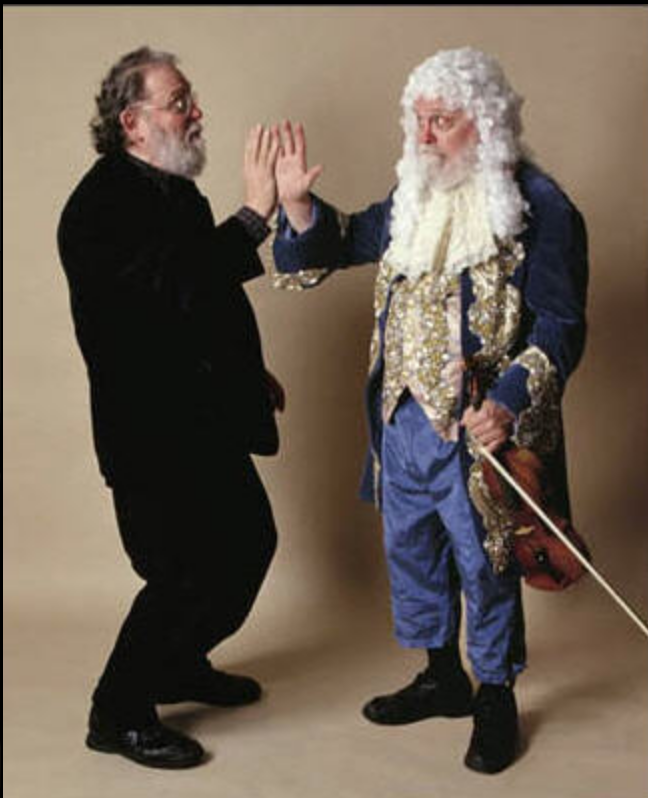
So it was with Peter Schickele, who was a very serious musician indeed. He had a master’s degree in composition from Julliard and was an excellent bassoonist. Okay, well and good. He might have ended up spending his life playing the bassoon in a symphony orchestra (which would have been perfectly fine, of course, if perhaps not terribly remunerative) had it not been for his early introduction to the music of Spike Jones. He heard a recording of Jones’ “Serenade to a Jerk” at age 10 and “was smitten by the King of Corn’s use of outrageous instruments and sound effects—like car horns and goat bleats—to burlesque popular songs.”1
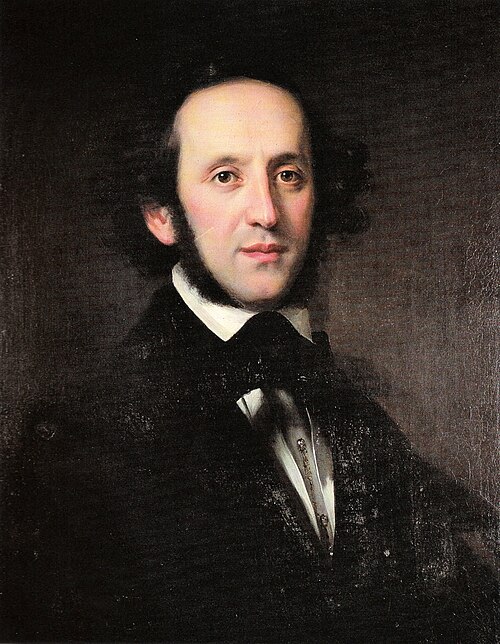
Image provided via Wikimedia Commons–oil portrait by Edward Magnus, Berlin State Library
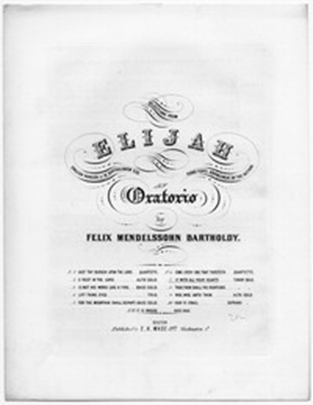
We don’t typically think of Felix Mendelssohn as a great outdoorsman nor as a composer of intimate songs. He’s associated most commonly with big orchestral works, notably his symphonies and concerti. His second area of expertise is in the area of big choral works, either his own (Elijah) or those of J. S. Bach. In fact, Mendelssohn was pretty much single-handedly responsible for getting Bach’s great music back into the public sphere, starting with his direction in 1829 of Bach’s St. Matthew’s Passion in Berlin. Mendelssohn was only 20 at the time, and for the rest of his short life he was profoundly influenced by Bach. In fact, Mendelssohn’s oratorio Elijah, his final large-scale masterwork achievement completed before his death, was written very much in the style of the Passion. (If you’re curious about how and why this young man was so taken with a Baroque composer whose works had completely fallen out of favor, you can’t do better than to read this article that lays out the whole chain of transmission. Key sentence: “Only the advent of an extraordinary individual could redirect an entire society’s attention towards a forgotten composer.”)
But enough of that. What about these outdoorsy songs? Well, I honestly don’t know why the rather frail young man who suffered from chronic ill health all his life liked being out in nature; I would have thought that he’d stick close to home and its comforts. But he wrote a whole set of lieder that were subtitled “To be sung outdoors” (“Im Freien zu singen”) and actively sought out lyrics to be used. In one letter he asked for his friend the poet Karl Klingemann to “send me a song or a pair, to be sung in autumn, or better yet in summer, or in spring, on the water or in a meadow or on a bridge, or in a forest or garden. …” And we do have one description in a letter to his mother of a time when Mendelssohn indeed got to fulfill his dream of an open-air concert:
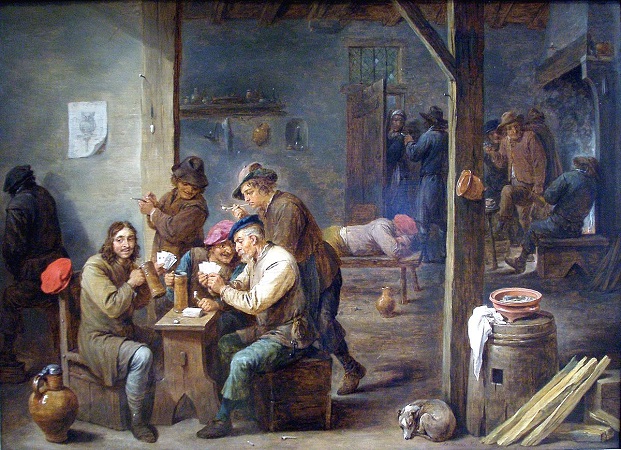
“In the Tavern” by David Teniers the Younger, 1610-1690, from The National Gallery of Art, public domain
One of the most popular concert choral works of the 20th century is Carmina Burana by Carl Orff. I’ve written a book about it, and I’d encourage you to take a look if your own group is involved in a performance. Below is a version of a chapter about one selection, “In Taberna,” which we’re including in an upcoming concert called “Harmony and Hops,” all about the joys of Germany and drinking, in whatever combination we can come up with.
This particular piece is part of a larger section of Carmina that is also titled “In Taberna.” In that section Orff includes some texts about the joys of drinking, gambling, and lust. It’s fair to say that it’s this section that has given Carmina as a whole its scandalous reputation of being sacrilegious, but in reality none of these pieces are directly about church institutions at all. That whole connection stems from the fact that the set of original medieval manuscripts from which the texts were taken happened to be found in a monastery. But even the piece “Ego sum Abbas/I Am the Abbot” isn’t about a real abbot at all but about an “abbot of the drinkers” who presides over a parodical “Drinkers’ Mass.” So don’t take any of this too seriously!
Note to my readers: This post is a chapter from the book I wrote about Mendelssohn’s oratorio Elijah, which I was privileged to perform with my own choir a number of years ago. This coming October the Cherry Creek Chorale will be performing one of Mendelssohn’s songs in a lovely, varied program titled “Harmony and Hops.” I’ll be writing specific posts about our selections, but in the meantime here’s this material on one of our composers:
I remember seeing this version of Mendelssohn’s name on a piano piece I was (very unsuccessfully) working on, and thinking, Is this another Mendelssohn? You’ll see both version of Felix’s last name used. So what gives? It’s a very complicated, and fascinating, story that concerns itself with Jewish culture in Europe and the role of anti-Semitism.
To begin with, Felix’s grandfather, Moses Mendelssohn, came to Berlin from a small town in Germany in 1743 at the age of 14, even though that city’s society was very hostile to Jews. He managed to become quite prominent in the philosophical and literary world, beating Immanuel Kant in an essay contest sponsored by the Berlin Academy. Frederick the Great even granted him the title of “Protected Jew,” which guaranteed his right to live peacefully in Berlin. (But of course this distinction only makes the lowly status of most Jews even more obvious by contrast.) Moses is a worthwhile historical figure in his own right and was hailed as the “German Socrates.” He devoted much of his later life to writings that eloquently supported the idea of religious freedom, saying that the state should not seek to control the religion of its citizens.
But even such a respected and beloved figure as Moses Mendelssohn couldn’t wipe out the widespread anti-Semitism in European culture. So Abraham, Moses’ son and Felix’s father, took several steps to distance himself and his family from their Jewish heritage. One of those actions was to adopt the surname “Bartholdy,” an action suggested by Abraham’s brother-in-law, Jakob Salomon, who took the name from a property he had acquired. Abraham urged Felix to drop the Mendelssohn name and just use Bartholdy, but even though Felix was baptized as a Protestant and married a minister’s daughter, he refused to drop his use of Mendelssohn. It’s never possible to know exactly what was going on in the mind and heart of someone from the past (or even someone in the present), but it seems to me that Felix wanted to honor both aspects of his background. Most of the time, his public knew him as Mendelssohn without the Bartholdy, but sometimes both names were listed. And that inconsistency has carried over until today.
Brazilian Beach Image by jorge luiz ribas from Pixabay
I think I’ve always associated “Ipanema” with “Ipana,” as in the toothpaste brand. (Sort of dates me, I know. Apparently it was brought back to market in 2011 as a “retro brand.”) Hey, I’m sure the girl has a great smile, although we’re not specifically told that in the song.
But it won’t surprise you to find out that there is nothing about dental hygiene here. Ipanema is a beach in Rio de Janeiro, and there was a bar about a block from there where the composer Antonio Carlos Jobim and the poet Vinicius de Moraes liked to sit and drink beer. They noticed a lovely 18-year-old girl often walking by on the sidewalk, either down to the beach or home from school (although it’s not clear how they knew where she was going). Her name was Hélo, short for Heloisa Eneida Menezes Pais Pinto. So inspired were they by her loveliness and her way of walking (“sheer poetry,” according to de Moraes) that they wrote the song on the spot, using the traditional manuscript material of bar napkins.
You may think of this blog post as a smorgasbord of information about Mahler’s Symphony No. 2 from which you can pick and choose what seems most relevant to you. Use the table of contents box above or just scroll through and see what catches your eye. The notes for each movement include a link to a corresponding podcast episode from a delightful series called “Embrace Everything.” These episodes are only about 40 minutes long and are packed with goodies. You’ll enjoy them and profit at the same time.