
Podcast: Play in new window | Download
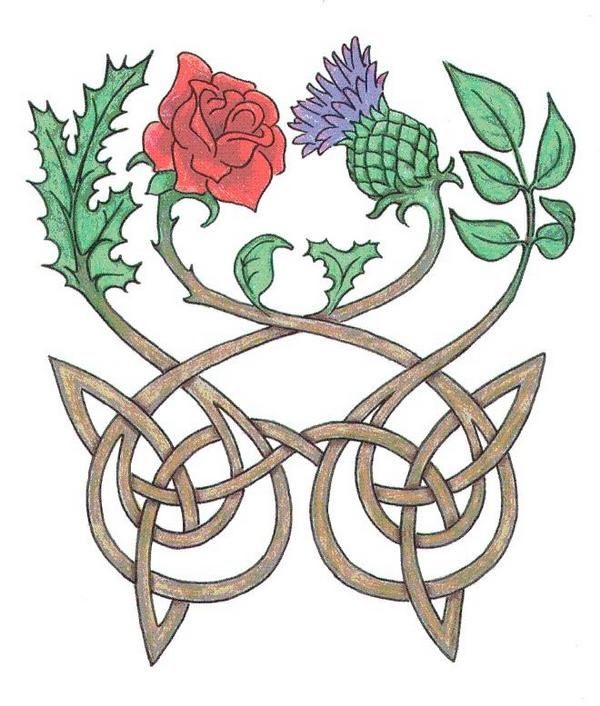
https://jp.pinterest.com/pin/602919468901757681/
I could just quote the e-mail sent to me by the composer/arranger of “Thistle and Rose (with ‘Ye Bonnie Banks and Braes of Bonnie Doon’),” Phyllis White, in answer to my inquiries about her thought processes as she wrote the piece, and you’d be quite well informed. I will indeed quote her later in this post. Have to say that it’s a total joy when I can communicate with living musicians as I’ve been able to do here. Let me first, though, unpack the symbolism of the thistle and the rose, which stand for Scotland and for England respectively. The story about the thistle comes from an incident in Scotland’s history:
It was 1263 when King Haakon’s fleet of battle-hardened Norsemen was blown off course and landed on the shores of Largs in Ayrshire. To their delight there was a sleeping Scottish army nearby. Not suspecting an attack, the Scottish were doomed to suffer an ambush. The Norsemen removed their boots in preparation for sneaking up on the slumbering soldiers. Fortunately, a field of thorny thistle flowers surrounded the Scottish. One Norse soldier, stepping on a thorn, yelled out in pain. This scream woke the Scottish men, who jumped into action and slaughtered the invading Norsemen.1


 Answer: a lot. Like, a whole lot. The following isn’t at all definitive, but it should give you a sense of the historical milieu from which the song came.
 If you had been around in 1902 and invited to the coronation of Queen Victoria’s son Edward VII (“Bertie” to his friends), you would have heard the premier performance of Sir Hubert Parry’s setting of Psalm 122 from the Church of England’s Book of Common Prayer, always known by its opening words: “I Was Glad.”
