A Problematic Musical with a Stormy Theme Song–“When You Walk through a Storm”

Image by Simon from Pixabay

Would a musical be produced today that’s built around the idea of sticking with an abusive spouse no matter what and to some extent normalizing the abuse? Could it include the line, “Has it ever happened to you? Has anyone ever hit you — without hurtin’?” To which the answer is yes: “It is possible, dear, fer someone to hit you — hit you hard — and not hurt at all.” And that line is delivered from a mother to a daughter, thus paving the way for perpetuating the cycle of abuse. Honestly! The musical is Rodgers and Hammerstein’s 1945 Carousel, and it’s an odd duck, often labeled as a “problem” musical or even as “the wife-beater musical.” Billy Bigelow, said wife-beater and main villain, echoes other characters in popular theater such as Stanley Kowalski in A Streetcar Named Desire and John Wayne’s character in the film McLintock!, to name just a couple, who hit their wives and not only get away with it but whose wives respond lovingly. (I am horrified by the spanking scene at the end of McLintock!, and apparently it’s not the only such scene in the movie.) When he’s asked about his abuse by the Starkeeper, head man in heaven’s waiting room, Billy Bigelow says he does not beat his wife. “I wouldn’t beat a little thing like that — I hit her,” he explains. But to answer the question I posed at the beginning of this paragraph: Yes, indeed, Carousel is performed today, sometimes with the problematic lines cut and sometimes with them included. One production compromised by having the dead Billy shake his head “No!” in response to the “not hurt at all” line. That’s perhaps the best way to deal with the issue, since just cutting those few lines in no way erases the overall arc of the plot. Indeed, Carousel was considered groundbreaking at the time of its original production because of its anti-hero lead male character and its tragic plot. Rodgers and Hammerstein had already broken new ground in their first collaboration, Oklahoma!, which used the songs to advance a well-developed plot, and Hammerstein had included controversial ideas about racism in his collaboration with Jerome Kern for Show Boat.

Read more

Sweet Charity’s Sisterly Sourcing and Songs

Actress Giulietta Masina in Nights of Cabiria; licensed under Creative Commons https://creativecommons.org/licenses/by-sa/4.0/legalcode

The Sourcing

The Broadway musical Sweet Charity opened in 1966 to rave reviews, sweeping up nine Tony nominations and winning one, lasting for a respectable 600+ performances and then being revived many times, both in the US and abroad. Bob Fosse won the Tony for choreography and then ended up directing the film version, his directorial debut in that genre. Everybody could be pretty happy about how this story about “a girl who wanted to be loved” turned out. But where did the idea for the whole thing come from in the first place?

All sources I’ve consulted agree that the precursor to the plot of Sweet Charity was the 1957 film by famous Italian director Federico Fellini called Nights of Cabiria, which concerns an ever-hopeful prostitute who never loses her optimism that someday she’ll find true love and happiness. And where did he get the idea for the plot, you ask? Well, often the source of ideas is completely unknown, even to the artist him/herself. (One of the most irritating questions you can ask an author is, “Where do you get the ideas for your books?” The only legitimate answer is usually a shrug, perhaps accompanied by an eye roll.) But for this story we do have at least somewhat of a source, probably gleaned from Fellini’s letters or other papers. It’s not terribly upbeat: “The film took its inspiration from news reports of a woman’s severed head retrieved in a lake and stories by Wanda, a shantytown prostitute Fellini met” on the set of a previous movie. (Wikipedia) The mystery of creativity, of course, is that lots of other people had read that head-in-the-lake story, and Wanda probably talked to lots of other people on the film set. But only Fellini got the idea of making those disparate elements into a movie. He started the film with his main character ending up in the river, not a lake, and still in possession of her head—but having been pushed in by her cad of a boyfriend who then stole all of her money. The story went on from there with Cabiria going from cad to cad; at the end she was left alone but still hopeful.

Read more

Were the Hills Ever Really Alive with the Sound of Music?

The real Maria von Trapp, late in life. Image accessed via https://www.factinate.com/wp-content/uploads/2020/12/Untitled-28-1.jpg

In other words, is there a true story behind the musical? And of course there is, and it’s much more interesting than the plot that could be crammed onto the stage or into a film. (Note the proper use of prepositions.)

We all know that when we see the words “based on a true story” at the beginning of a biopic or a docudrama that we’d better not take the storyline too seriously. Those warnings don’t appear at the beginning of The Sound of Music, but perhaps they should. I’ve thoroughly enjoyed researching the real von Trapp family and would urge you to follow the links below to get a fuller picture than I can give here.

Read more

The Many Creative Wellsprings for the Musical “Guys and Dolls”

English: Portion of title page of Guys and Dolls, Libretto and Vocal book, printed by Music Theatre International, 1978.

First, let’s define a few terms that will help along the way in outlining the wellsprings mentioned in the title above, particularly “libretto” or “lyrics” vs. “book.” I’ve run into these terms before and never quite gotten them straight. So the “libretto” (literally “little book” in Italian and typically used for opera) is the text of the sung parts, including the individual songs (or arias, again used primarily in opera) and any recitatives (that is, sung exposition). While an opera is usually all sung (but there are certainly exceptions such as The Magic Flute), musical theater typically has spoken parts as well. So the “book” is the compendium of everything the performers say or sing, as well as the stage directions. And thus the stage is set (ahem) for endless combinations, borrowings and re-workings. You’ll hear about someone getting an idea for a musical or an opera from seeing a play or reading a book and then going through the long and sometimes tortured process that will turn one format into another. Unless the creative mind behind it all is capable of doing everything—the words, the music, the staging—various roles have to be farmed out.

Read more

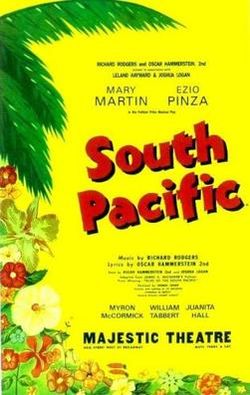
What Serious Moral/Social Issue Is Addressed in the Musical “South Pacific”?

Musical1949-SouthPacific-OriginalPoster.jpg
Original Broadway poster, 1949, accessed via Wikipedia

And the answer is: racial prejudice. If you don’t know the plot of this musical and think it’s just something lighthearted, you might be surprised by its content. The location is an island in the (where else?) south Pacific during World War II. The central conflict between the two main characters, Nellie the Naval nurse and Emile, the French planter with whom she falls in love, is that Nellie finds it very difficult to accept that Emile has been married before to a “dark-skinned Polynesian” and has two “mixed race” children. It’s only after Emile is almost killed in a secret mission to spy on the Japanese forces that Nellie realizes how much she loves him and his children. Another character, the Naval officer Cable, falls in love with a Polynesian girl, Liat, and that romance is also considered pretty scandalous. He decides that he can’t marry her because of how his family back home would react. He’s killed during the spy mission. But before he goes off to that fate he sings a very famous (and controversial at the time) song about how prejudice develops: “You’ve Got to be Carefully Taught.”

Read more

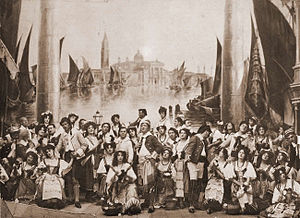
A Neglected Gilbert & Sullivan Gem and Its Complicated Finale–The Gondoliers

From Act I of the 1907 D’Oyly Carte production at the Savoy Theatre; image accessed via Wikipedia.

I’m a certified Gilbert & Sullivan junkie, as are my husband and his family. When I was in grade school I had a set of Golden Something-or-Other records and a little record player (yes, it’s true), and one of those ancient disks had G&S selections on it. I can remember listening over and over again to the Mikado’s “My Object All Sublime” and trying to figure out what on earth the words meant about the punishment doled out to a “billiard shark” (whatever that was): “On a cloth untrue/With a twisted cue/And elliptical billiard balls!” I finally realized that this was a pool table with a distorted tabletop, cues and balls. I’ve seen numerous productions of The Mikado and even two performances of the Hot Mikado, a jazz version that is, like, totally great. (The gentlemen of Japan are dressed in zoot suits.) I’ve seen H.M.S. Pinafore and The Pirates of Penzance on both film and in live performances. (Check out the Linda Ronstadt/Kevin Kline/Angela Lansbury version.) I’ve seen a live performance of Patience, one of the lesser-known in the canon. But until I participated in a concert that included the finale from The Gondoliers I’d never even heard of this particular creation.

Read more

In which I follow the quest to find out the origin of “The Quest”

I’m always interested in the origins of things: the why. So for the selection “The Impossible Dream” (titled “The Quest” in the actual script) from Man of La Mancha that I’ve sung with my own choir I wanted to know why on earth a popular Broadway show had been made from a 400-year-old, 700-page novel, Miguel de Cervantes’ Don Quixote. Doesn’t sound all that likely, does it? And yet it happened. (There are lots of other unlikely origins for Broadway musicals, though—Kiss Me, Kate is based on Shakespeare’s The Taming of the Shrew.)

Read more