A Compact Masterpiece–Mozart’s Coronation Mass

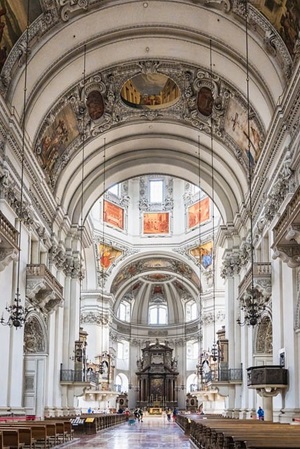
Interior of Salzburg Cathedral, where the first performance of the Coronation Mass probably took place. Image source: Image by 🌼Christel🌼 from Pixabay

Unemployment is a terrible thing—except when it leads to the composition of a masterpiece. In Mozart’s case he was only 23 years old when he wrote his Coronation Mass in 1779, having reluctantly taken up once again the position of court organist and sacred music composer in Salzburg after having failed to find anything more attractive over 16 months of traveling around Europe. He heartily disliked his birthplace Salzburg, considering it to be a backwater, and he also disliked his employer, Archbishop Hieronymous Colloredo. Mozart’s position lasted only two years, at which time the Archbishop decided he’d had enough of his court composer’s frequent absences and disrespectful behavior. Mozart describes in a letter being “kicked in the backside” by the Archbishop’s steward, an act which ended his career in Salzburg. He’d go on to (some) fame and (less) fortune in Vienna, where he would live for only ten more years.

During his time at the Archbishop’s court he wrote only two masses, one of which is rarely performed and the other is the one labeled “coronation” for reasons that remain somewhat murky. Mozart had written about a dozen masses before returning to his native city, but this would be the first one published, and it was probably first performed on Easter Sunday, April 4, in the Salzburg cathedral. He dated the mass’s completion as March 23, so the choir, soloists and orchestra had less than two weeks to prepare. Yikes! (But they were, after all, paid professionals.)
Read more

The Text of the “Te Deum”

Imagine yourself to have traveled back in time to around 400 A.D. You’re in the Italian city of Milan, standing in the Basilica of Saint Lawrence, at this point a Roman Catholic church but showing definite signs of its early origins in the Roman Empire. Suddenly you hear a choir of monks start to sing a hymn (I almost wrote “an ancient hymn,” but of course to them it’s brand new) starting with the words “Te Deum.” ‘Hmmm,’ you might think. ‘I’ve sung those words myself in October 2024 with the Cherry Creek Chorale, my own wonderful choir. Cool!’  This (now) ancient hymn is usually dated to around 390 and seen as possibly written by either Saint Ambrose or Saint Augustine. Or perhaps someone else, for all we know. Whoever wrote it, however, surely knew what he (or she!) was doing. Some real heavy hitters over the centuries have taken a crack at it, with one of the most famous being Franz Joseph Haydn in around 1800.

Haydn was a tremendously prolific and popular composer. His output is astonishing: this evening I scrolled through the list of his compositions on Wikipedia, and honestly–I think it probably took me longer to do that than it took Haydn to write the piece. He produced a huge range of compositions, from symphonies to oratorios to string quartets to masses to operas to folk song arrangements to everything else you can possibly imagine. (If there had been MOOG synthesizers around back then, be assured that he’d have written a concerto or two using that instrument.) The composer spent 30 years under the patronage of the Hungarian Prince Esterhazy, who was extremely jealous of Haydn’s time. The patronage was therefore both a blessing and a curse: Haydn had an assured income, but he was also limited in his ability to travel and to take on other commissions. The prince was finally persuaded, however, to allow Haydn to fulfill the request from the Austrian Empress Maria Theresa to write her a setting of the “Te Deum.”

Read more

The Concept of the “Kyrie”

Image by falco from Pixabay; do you recognize what story is being portrayed in this sculpture and how it relates to the concept of mercy?

The choir to which I belong, the Cherry Creek Chorale, is privileged to include a composer, Gloria Srikijkarn, whose works we have performed at several concerts. For our October 2022 concert Songs of Thanksgiving we have a section titled “The Valley of the Shadow” that includes her setting of “Kyrie.” She says that she wrote this moving and beautiful piece “at a very dark time in my life.”

The simple text comes from the service of the Roman Catholic Mass but is often, as here, used as a stand-alone piece. It’s always helpful, though, no matter how separate from the original a version is, to look at how it was used in the first place. So if you were to attend an actual service of the Mass you’d participate in singing the text right after the priest or minister had addressed the congregation by saying,

Read more

Does “Maris” Mean “Mary” in “Ave Maris Stella”?

Image by enriquelopezgarre from Pixabay

Well I’m glad you asked! Because “Maris” doesn’t mean “Mary.” It means “sea” or “ocean.” So the title literally means, if you keep the same word order: “Hail, Sea Star.” So where did that wording come from?

The original lyrics date back to somewhere around the 9th century and have been attributed to several authors; no final conclusion has been reached on that issue. The words present Mary as a merciful and loving mother, with “Star of the Sea” being a title that especially appealed to travelers praying for a safe journey. The words were sung to Gregorian chant music, which is always anonymous.

Read more

How Does “Ave Maria” Fit into the Christmas Story?

Leonardo da Vinci, “The Annunciation,” via Wikimedia Commons, public domain

It fits in as the precipitating incident of the story as a whole, since Christmas revolves around the birth of Christ. “Hail, Mary!” is the greeting that the angel Gabriel gives to Mary when he appears to her and tells her that she will be the mother of the Messiah. This event is typically called the “annnunciation,” or announcement. Note that this event happens nine months before the birth of Christ, not at Christmas itself. A version of the angel’s words has been incorporated into the worship services of both the Roman Catholic and the Orthodox churches. Let me begin with a literal word-for-word translation from both languages involved, Latin and Russian.

Read more