

My own choir, the Cherry Creek Chorale, has performed quite of few of Elaine Hagenberg’s choral compositions, and we were privileged to be part of the original commissioning consortium for her first extended work, Illuminare. She burst on the classical choral world in 2013 with “I Will Be a Child of Peace,” an arrangement of a Shaker hymn, and hasn’t looked back since. We are now heading towards yet another Hagenberg premiere, her new major work Aeterna Via. We are performing the Colorado premiere on May 8 & 9, and its worldwide introduction will be in Paris this June. If you live in the Denver metro area and would like to attend this very special concert, you can get your tickets here. Below is a two-part post about some other Hagenberg works we’ve performed in the past. “You Do Not Walk Alone” will be a part of this upcoming program in May.
Celtic Music
A Deceptively-Simple Love Song: “Shule Aroon” or “Siúil a Rúin”
Podcast: Play in new window | Download
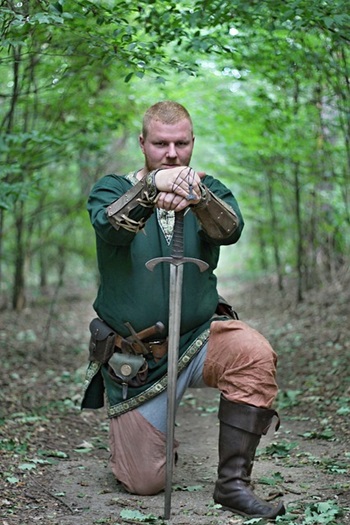
Sources are unanimous in saying that the origins of this Irish folk song are “somewhat unclear.” Since its theme is so universal (a woman left behind as her sweetheart goes to war), you could say that the exact historical reference doesn’t really matter all that much, but it’s always interesting to dig into such things (if you’re a history nerd like me). The most common theory about the song’s background says that it refers to the time of the British Glorious Revolution in 1688, when James II of England, a Roman Catholic, was deposed and replaced by William of Orange,1 a Protestant, and his wife Mary, the daughter of James by a previous marriage and also a Protestant. (If you want a fuller overview of this turbulent time, see my post about the song “Loch Lomond.”)
The Irish were solidly on the side of Catholicism, joining in with James II’s heirs in various attempts to wrest the throne from the wicked William’s hands. (That’s how they saw him, anyway.) But it was all in vain. By 1691, three years after William’s ascension to the English throne, the so-called Williamite War in Ireland was ended with the Treaty of Limerick (a town in Ireland).2 Although there were assurances of safety for Irish soldiers who remained at home, many of these men chose to go to France for military service there. (They were pretty savvy to leave, as the promises to those who stayed weren’t kept.) After all, if your profession is that of a soldier, and you’re forbidden to fight in your homeland, why not go somewhere you can? Louis XIV of France really wanted Irish soldiers to help him in his war against the Dutch, and William III was Dutch. So these exiled Irish soldiers could console themselves with the thought that they were continuing to fight the good fight. This exodus of Irish soldiers to France is called “the flight of the wild geese.” About 20,000 Irish in total fled Ireland, including about 6,000 women.
The Tumultuous Wedding of the Thistle and the Rose
Podcast: Play in new window | Download
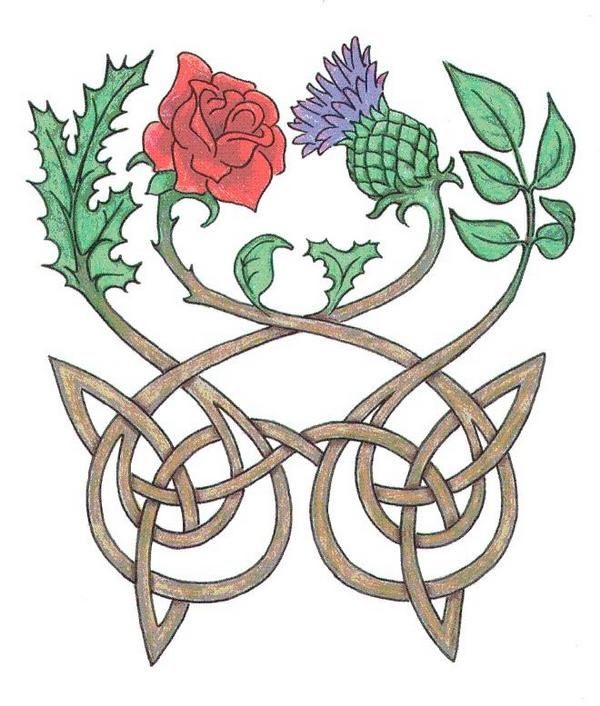
https://jp.pinterest.com/pin/602919468901757681/
I could just quote the e-mail sent to me by the composer/arranger of “Thistle and Rose (with ‘Ye Bonnie Banks and Braes of Bonnie Doon’),” Phyllis White, in answer to my inquiries about her thought processes as she wrote the piece, and you’d be quite well informed. I will indeed quote her later in this post. Have to say that it’s a total joy when I can communicate with living musicians as I’ve been able to do here. Let me first, though, unpack the symbolism of the thistle and the rose, which stand for Scotland and for England respectively. The story about the thistle comes from an incident in Scotland’s history:
It was 1263 when King Haakon’s fleet of battle-hardened Norsemen was blown off course and landed on the shores of Largs in Ayrshire. To their delight there was a sleeping Scottish army nearby. Not suspecting an attack, the Scottish were doomed to suffer an ambush. The Norsemen removed their boots in preparation for sneaking up on the slumbering soldiers. Fortunately, a field of thorny thistle flowers surrounded the Scottish. One Norse soldier, stepping on a thorn, yelled out in pain. This scream woke the Scottish men, who jumped into action and slaughtered the invading Norsemen.1
An Irish folk song with hazy roots and several meanings–“Oró, sé do bheatha abhaile”
Podcast: Play in new window | Download
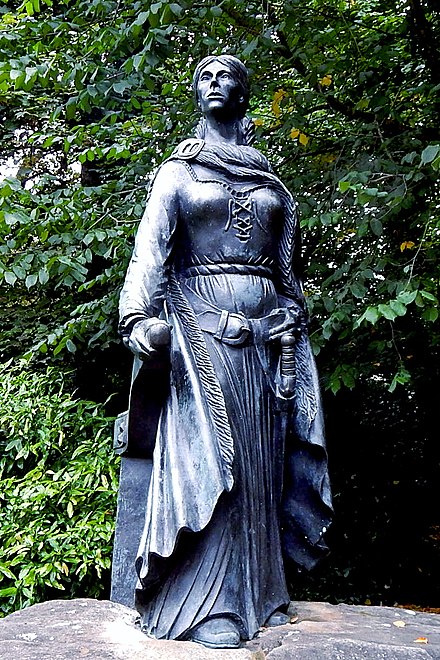
Oh man! Have I chased down a number of rabbit trails about this seemingly-simple song.
Here’s what seems to have happened: The inestimable Wikipedia says, “Similarly to many folk songs, the origins of this song are obscure.” To put it mildly! However, it seems to be the case that sometime in early Irish/Celtic history (and who knows what time period this actually was) a tradition developed of “hauling the bride home,” which took place a month after the original wedding and consisted of the new bride’s being “hauled” to her now-husband’s house. It isn’t clear to me where she’d stay for that month–at her father’s house, one would guess, but who knows? It’s important to note that the original folk song (if there is indeed such a thing) consisted only of the chorus.
Anyway, here’s how (we think) it went, again from Wikipedia:
The “Hauling home” was bringing home the bride to her husband’s house after marriage. It was usually a month or so after the wedding, and was celebrated as an occasion next only in importance to the wedding itself. The bridegroom brought home his bride at the head of a triumphal procession—all on cars or on horseback. I well remember one where the bride rode on a pillion behind her husband. As they enter the house the bridegroom is supposed to speak or sing:
Oro, welcome home, I would rather have you than a hundred milch cows:
Oro, welcome home, ’tis you are happy with prosperity [in store for you].”
The piper, seated outside the house at the arrival of the party, playing hard [i.e. with great spirit]: nearly all who were at the wedding a month previous being in the procession. Oh, for the good old times!
“A Parting Glass” Is Offered to Those Who Stay Behind
Podcast: Play in new window | Download

There are many versions of this song, with varying words and melodies. I’ve tried to distill the various ideas down into something digestible, always keeping in mind that it’s a folk song and its origins are therefore murky. The initial inspiration may have come from a farewell letter written by Scotsman Thomas Armstrong on the eve of his execution in 1605 for border raiding. Here’s what he wrote:
This night is my departing night, For here nae langer must I stay;
There’s neither friend nor foe o’ mine, But wishes me away.
What I have done thro’ lack of wit, I never, never, can recall;
I hope ye’re a’ my friends as yet; Goodnight and joy be with you all!
Hard drinking and highway robbery—Whiskey & the Wild Rover
Podcast: Play in new window | Download
Several years ago, my own choir, the Cherry Creek Chorale, performed the suite Letters from Ireland, with arrangements of folk songs and also excerpts from letters. all put together by the contemporary composer/arranger Mark Brymer. I was so taken with the music that I wrote a companion book covering historical and literary information for the pieces. It’s available on this website and also from Amazon.
For our upcoming Celtic concert in March 2025 we’re singing just one arrangement from the suite, so I’ve extracted that material and am providing it for free on the blog. I’d encourage you, if your choir is singing the entire work, that you get the book.
For one section, Brymer combines two songs, “The Wild Rover” and “Whiskey in the Jar.” Here’s what I had to say about these two songs:
Is the song “Grace” based on real people and events?
Podcast: Play in new window | Download

The answer is a resounding “Yes!” You just never know until you start diving into a piece how much you can find out. Such is the case here–I’ve had quite a time finding out about the tragic love story of the Irishman Joseph Mary Plunkett and his beloved Grace Gifford. It’s hard to know even where to start, but here goes:
You may have looked at Joseph’s full name and questioned why his middle name is “Mary.” Was that his mother’s name, perhaps, and he had no sisters to carry it on? No. It was a symbol of his deep Roman Catholic faith and his devotion to the Virgin Mary. (I’m assuming that he added the name himself.) Plunkett seems at first glance to be a contradictory figure in Irish history, combining religious mysticism and hard-headed military abilities. In reality, though, Ireland’s desire to be an independent country and not under Protestant English rule stemmed at least in part from its loyalty to Catholicism. So Plunkett could help plan a violent bloody uprising against the British government and see it as a profoundly moral cause, which is exactly what he did with his fellow Irish revolutionaries in the spring of 1916 for an event known as the “Easter Uprising” because it started in Dublin on the Monday after Easter. “Wait!” you might say, “1916? World War I is going on at the same time. How did anyone have spare energy for carrying out a revolution?” Good question. In reality, at least part of the reason for this specific rebellion was that it was seen as a way for Irish men to escape conscription into the British army to fight in that war, since they certainly had no great loyalty towards England.
Is It Better to Take the High Road or the Low Road?
Podcast: Play in new window | Download

They’re both sad, but for one road the person is dead and for the other the person is grieved/bereaved. Which is which depends on the interpretation of the song you prefer.
Let me start by warning you that the history behind this innocuous-sounding song is right in my wheelhouse, or up my alley, or whatever expression you want to use. I’ll try to rein myself in, but it’s going to be hard. So hang in there with me to find out more than you thought possible about a song you’ve probably heard many times but never questioned. Let me just quote the chorus before we get started:
O you take the high road, and I’ll take the low road,
And I’ll be in Scotland afore ye,
But me and me true love will never meet again,
On the bonnie, bonnie banks of Loch Lomond.
The person who takes the low road is going to get to Scotland first but won’t ever see his or her true love again. So who’s speaking, and what’s going on?
So, What’s Up with the Celts, Anyway?
Podcast: Play in new window | Download
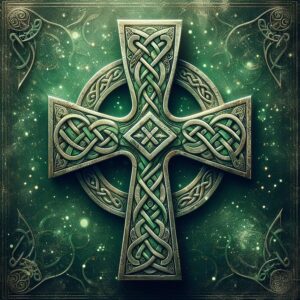
Celtic crosses, Celtic love knot jewelry, Celtic dancing, Celtic music . . . it’s an industry. Since my own choir, the Cherry Creek Chorale, does a Celtic-themed concert every other year, I wanted to find out more about the history of this term. Turns out that, as is usual when you try to reconstruct the past, especially the ancient past, it ain’t all that easy to nail things down. We’re used to thinking in terms of clear-cut events and eras when we look at history, but those divisions are often more for the sake of convenience than reflections of actual reality.
A Mysterious Text with Three Beautiful Settings and a Bonus: “Gaelic Blessing/Deep Peace”

The miniature gem “Gaelic Blessing” written by John Rutter in 1978 has an interesting connection with the choral music scene in the US. How did that happen with an English composer and a Scottish text? It all started with one of those inexplicable human connections that can never be completely teased out.
John Rutter started his long relationship with America in 1974 when he was contacted by a church choir director, Mel Olson, in Omaha Nebraska, and asked to write a 20-minute piece for Olson’s Chancel Choir. How did someone from Omaha even know about John Rutter, then in the very early stages of his composing career? I don’t know for sure, but it seems possible that Olson had gotten hold of Rutter’s early Christmas music and liked it. Whatever the reason, Rutter was very pleased to get the commission and ended up writing his magnificent Gloria. As he said in answer to my inquiry when I wrote about that piece, “Other commissions from the USA just seemed to follow, to the point where I was able to look upon America as my second home.” And one of those commissions was for “Gaelic Blessing” in 1978, but this time it was the Chancel Choir that reached out for a piece they could dedicate to Olson. I haven’t been able to find a detailed description of Olson’s career, but I’m wondering if this was a farewell gift to him from that choir because he was leaving Omaha. He ended up at in California, where in 1985 he was involved in the initial performances of Rutter’s Requiem.